
The Constitution of India is an interesting document! Some Indians put it on a pedestal higher than God and almost worship it while many others despise it, as if it’s a curse of a demon god. How and why does this book attract such extreme reverence and contempt at the same time, from the people who are all Indians? Does it have to do with what it contains? Or are there reasons beyond its contents? Exploring answers to these questions, one happens to navigate through a searing cauldron of societal, political, religious and cultural ailment that has gripped the Indian nation. This exploration is certainly not a delightful journey, it is indeed a tribulation in many ways, and yet worth undertaking, for some good may arise out of it.
The very making of the Indian constitution offers a part of the answer to the questions raised above. The disgruntled ascribe a colonial origin to it and show disdain that all that is colonial deserves. But is the Indian constitution colonial in its origin or content? The answer is an emphatic no. A constitution is essentially a document that defines a country’s governance structure, its ethos and its aspirations. As far as governance structure is concerned, while continuing with some administrative structures of the colonial period (which were essential for continuity and holding together a nascent country formed by amalgamation of hundreds of disparate and warring princely states and regions), the constitution adopted the best form of governance known to humankind then and even now—democracy. Does this continuation of administrative structures from the colonial period make it colonial in origin? Certainly not. In fact, in spirit, the Constitution of India is fundamentally Indian and can be traced back to its glorious ancient past.
The Constitution of India is an interesting document! Some Indians put it on a pedestal higher than God and almost worship it while many others despise it, as if it’s a curse of a demon god. How and why does this book attract such extreme reverence and contempt at the same time, from the people who are all Indians? Does it have to do with what it contains? Or are there reasons beyond its contents? Exploring answers to these questions, one happens to navigate through a searing cauldron of societal, political, religious and cultural ailment that has gripped the Indian nation. This exploration is certainly not a delightful journey, it is indeed a tribulation in many ways, and yet worth undertaking, for some good may arise out of it.
The Constitution of India enshrines fundamental rights guaranteed to the people and citizens of the country, and the most citizen-centric Directive Principles of State Policy. The Indian Constitution is arguably one of the best constitutions of the world. No rational human being can hate or be unhappy with the core provisions of the Indian Constitution enshrined in its Preamble, Fundamental Rights, Directive Principles of State Policy, etc. The provisions related to Union and State Legislatures, financial management, Judiciary, and other aspects of governance may have some scope for improvement as we gain experience and mature as a country. The Constitution itself provides for such improvement in the form of amendments, to meet demands of time. So, there is no reason why people should dislike the constitution for its contents. Ironically, most of the people who express such dislikes are the ones who have never bothered to read a word of the Constitution!
If it is not its colonial origin, or its content, then what can possibly divide people in those two extreme camps? The answer to this perplexity is what is attempted in the succeeding paragraphs.
Some of the disgruntled dislike the constitution simply because it was written by Dr. Ambedkar. Their upbringing in a caste-ridden society and the politics that is played around it makes them hate anything and everything that has to do with Dr. Ambedkar and renders them incapable of seeing any good whatsoever in what he said or did! As if the words written by an untouchable are also untouchable and unacceptable!
Some dislike the constitution as they see it as a source of reservations and more as a source of their deprivation!
They see reservation as an injustice or punishment meted out to them for wrongs they did not commit. Thus, they take the Constitution as a source of this perceived injustice and hence develop disregard for it.
Then there is another class of people who hate the Constitution for very different reasons. They are the ones who have read it, or at least know very well what it contains and what it means. They are not naïve enough to dislike it simply because it was written (or at least significantly shaped) by Dr. Ambedkar. Nor are they disturbed by it being a source of reservation.
Instead, they are opposed to the very ethos and values of equality, justice, liberty, fraternity, and human dignity enshrined in the Constitution. They see these values as a real threat to their historical supremacy and privileges that they have enjoyed for centuries. Though they may be a microscopic minority, they continue to influence public opinion. Driven by self-interest, they promote caste and religious divisions and work relentlessly to prevent people from uniting against inequality. They are also the ones who talk about changing the Constitution.
So far, we have discussed one side—the haters. There is another side who tend to deify the Constitution and worship it. Why do they do so? Interestingly, for reasons similar to those of the haters. They revere it because it was associated with Dr. Ambedkar, and because they see it as a source of reservation—an instrument of redressal for historical injustice.
Due to their upbringing, they too are often unable to see anything wrong in what Dr. Ambedkar said or did. The only difference is that their inability does not come from caste prejudice. These are the people who have deified Dr. Ambedkar and claimed exclusive ownership of his legacy, including the Constitution. Sometimes, such exclusivity and its expressions can push the disgruntled and even neutral people further away from both Dr. Ambedkar and the Constitution.
Among the admirers of the Constitution, there is another smaller group who do not deify it. They respect it for the humanistic values it upholds—dignity of the individual, equality, justice, and the idea of a welfare state. They have read it or at least understand its essence. They strive to unite people and work toward eradicating caste discrimination and religious inequality, as envisioned by the Constitution.
India today is a complex mixture of all these perspectives—people shaped by upbringing, interest, misunderstanding, confusion, and belief. As we mark the 75th anniversary of the adoption of the Constitution, society appears as divided as ever, if not more. In hindsight, we may even seem more divided, more selfish, more narrow-minded, and less empathetic than the framers of our Constitution.
The Constituent Assembly that adopted the Constitution represented all sections of society—the privileged, the less privileged, and even the disadvantaged. Despite widespread illiteracy and deep-rooted social evils like caste discrimination, untouchability, patriarchy, and feudalism, they rose above their differences, compromised, and embraced humanistic values for the future of a free nation.
In contrast, we must ask ourselves: have we truly progressed as a society? Have we become more humane, or have we regressed—still trapped in caste prejudices and self-interest over the larger interest of the nation?
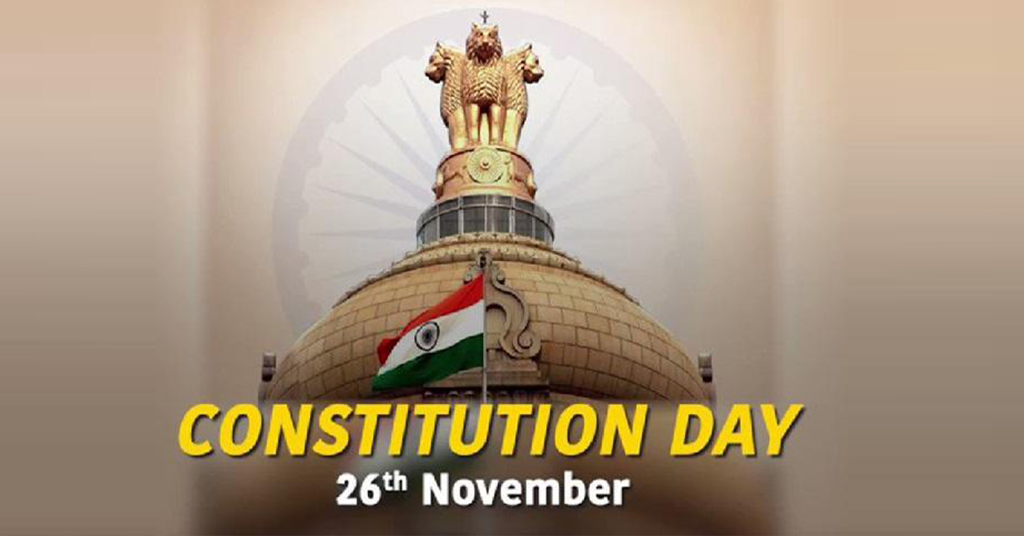
As we celebrate Constitution Day, it is important to spread awareness about its provisions. The Constitution belongs to everyone; it ensures dignity for all. We must recognize the futility of prejudice and exclusive claims, and instead embrace it as a powerful instrument for ensuring equality, unity, and integrity of the nation.