Unity in Diversity’ is the phrase that we have been hearing since our childhood. Numerous programmes and activities are carried out by government and non- government agencies to emphasize the need of unity in our diverse country. I have been always perplexed with a persistent question in my mind. Can there be unity in a society where there is so much inequality in all spheres of life? Is it possible for people to live with unity when they are divided on the lines of verna, caste, gender, religion, language and region etc.? Can a person who is a victim of caste atrocity, discrimination or gender bias, ever feel a sense of unity with the oppressor? Or is it possible for the oppressor to have a sense of unity with the oppressed?
These questions, I’m sure, would cross every mind that can think of this phrase as not mere slogan. If the answers to all these questions are in negative, does that mean it is not possible to have unity in diversity? It is indeed possible! But there is a prerequisite that must be met for unity to become a reality. ‘Equality’ is that prerequisite! Unless there is equality in diversity, we cannot think of unity in such diversity. Thus, achieving equality is the first step towards bringing unity in society.
Equality means, all the people, irrespective of their diversity, are equal human beings. That all people accept each other as equals and treat everyone with equality. For this to happen, all the barriers that exist in the way of equality will have to be removed. First such barrier is the barrier of verna and caste system. This artificial system divides people in unequal groups, legitimises inequality and discrimination and must be irradicated from the society. No notion of equality can ever survive in the presence of the verna and caste system.
Patriarchy is another potent hurdle in the of achieving equality in the society. It entails and legitimises gender bias, discrimination against women, subjugation of women and concentrates authority in the hands of men. Plight of other genders is still worse.
Abolishing patriarchy therefore, is necessary for bringing equality in the society.
Religion, culture, language, etc. are an integral part of peoples’ lives and do not, fundamentally, legitimise or entail discrimination among human beings. Though, some vested interests have succeeded in spreading the misconception that their religion or culture preach discrimination. In this scenario, it is necessary to remove this misconception and establish that all religions are for the good of human beings and that none, fundamentally, legitimise discrimination.
The preamble of the Constitution of India talks about ‘unity and integrity of the nation’ as one of the ultimate objectives of the Constitution and the entire apparatus of the state that it establishes. It is important to note that the Constitution places ‘assuring the dignity of the individual’ even before ‘the unity and integrity of the nation’ as its ultimate objective. The primacy accorded to ‘the dignity of the individual’ over ‘the unity and integrity of the nation’ is not a matter of inadvertence; there is a profound thought behind it. The makers of the Constitution were fully aware that ‘unity and integrity of the nation’ is not possible without ‘the dignity of the individual’. There can be no unity among the people of this country if every individual is not ensured of human dignity. Equality is the sine qua none of dignity and there can be no ‘dignity of individual’ if people are discriminated, ill-treated and subjugated. There can be no ‘unity of the nation’ if there is no equality.
‘Nation’ is a social construct and the concept of ‘nation’ goes far beyond the territory and the people living in it. What essentially gives a territory and its people an identity of a nation is the ‘oneness or unity’ they feel in terms of their history, ancestry, culture, their present and future aspirations. Such ‘oneness’ is not possible without equality among all the people of this country. So, we cannot think of becoming a nation without establishing equality- social, gender, cultural, religious, 3 linguistic, regional, etc.
The preamble talks about securing to all its citizens, justice, liberty, equality and fraternity to assure ‘the dignity of the individual and unity and integrity of nation’. Thus, it spells out the prerequisites of the unity and also the means to achieve the same. Equality is perhaps the most significant means to achieve unity in the diversity that exists in our country.
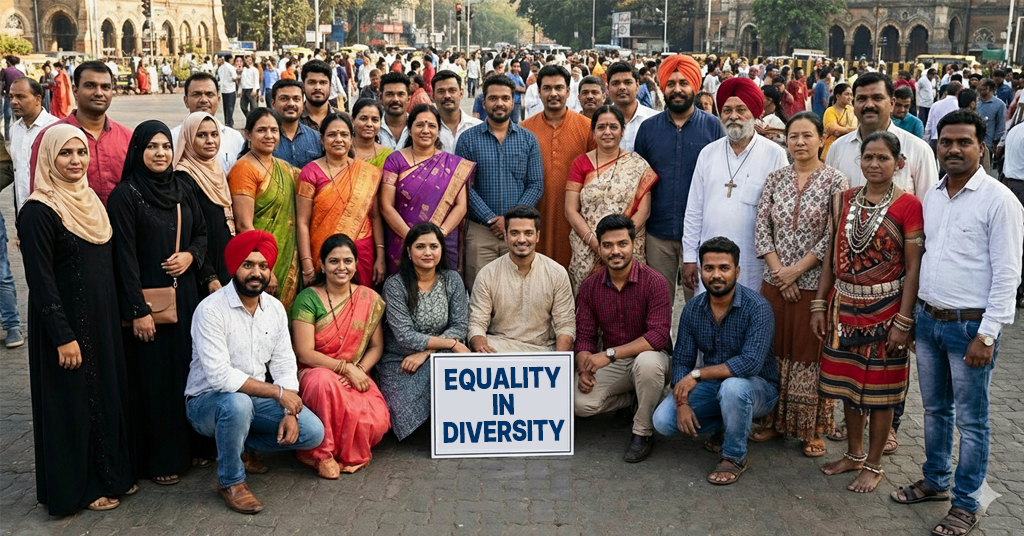
In the Preamble of the Constitution, ‘we the people of India’ resolve to assure ‘the unity and integrity of the nation’. However, the people have been looking up to the state to do it, expecting the governments to bring equality. The governments appear to be ill- equipped to bring equality in the society and hence it is important that the people themselves take up the responsibility that the Constitution bestows upon them. It is heartening to see thousands of members of Movement21, coming from almost every kind of diversity that exists in India, striving to bring these values of equality in our country. Celebration of ‘Equality in Diversity’ week from 11th to 14th April is indeed a celebration of the efforts of the people to achieve this constitutional objective.
The celebrations begin on the birth anniversary of Jotiba Phule (11th April) and last till the birth anniversary of Dr Ambedkar (14th April). These two icons have a lion’s share in the efforts to bring equality in our diverse country during the last century and a half. Jotiba Phule worked for equality all his life. His work was not limited to any community sections of society, He worked for all sections of society, including women. Dr Ambedkar, continuing Jotiba’s legacy, worked all his life for bringing social and gender equality, for all in the country, not for any specific group of people. Their contribution was, in essence, towards bringing ‘equality in diversity’ that exists in our society and country. Thus, it is indeed very fitting that Movement21 celebrates ‘Equality in Diversity’ week, on their birth anniversaries.